

When the music moves you…
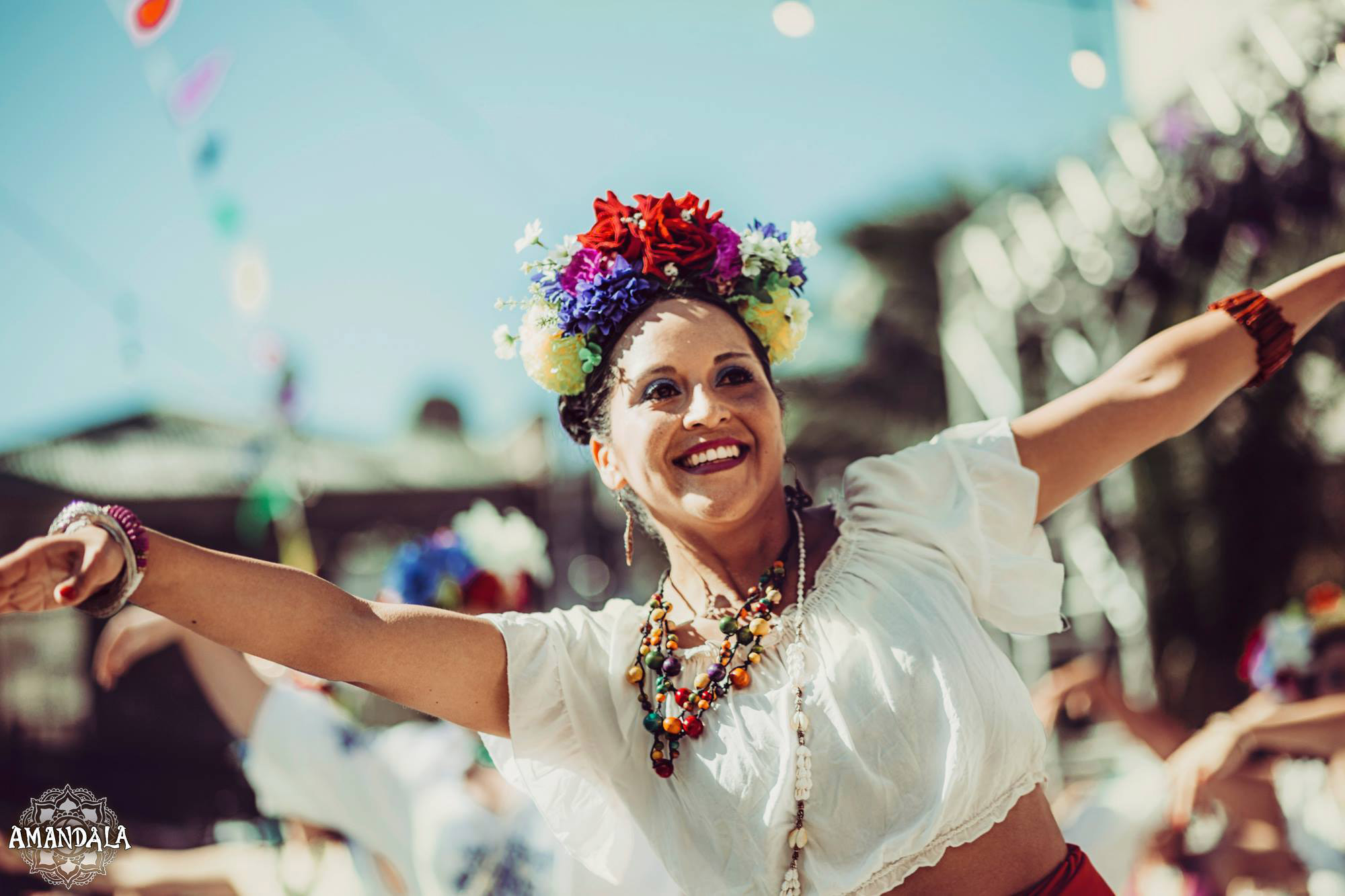 Most of the members of Wellington Batucada were inspired to join the group in the same way – we heard the drumming and it moved us… we couldn’t stand still – we just had to dance! Some of us have decided to join the band as drummers, and others just want to keep on dancing. Our dancers are an integral part of Wellington Batucada, just as they are in Brazil – and they provide the movement and spectacle that accompanies our music.
We are now accepting registrations for our 2025 dance course.
The beginners’ 6-week dance course runs from 3 August to 7 September 2025.
Check out the Join us page to find out more.
How it works in the Brazilian Carnaval
The performing Samba School is separated into different sections. The first section is called the Abre-alas and includes, at the most, fifteen performers. Since they are the first group the audience sees, each member has the important job of inciting the crowd to join in with the atmosphere and theme of the school.
The Velha Guardo is a group of men who can be identified by the white suits and hats they always wear in the parade. This group is usually at the end of the parade.
The Ala das Baianas are the section of women who wear large circular traditional skirts. The women dance in the skirts by spinning in circles, creating a frenzy of applause and often a standing ovation.
A couple called the porta-bandeira (female) and mestre-sala (male) dance together using the steps of the samba. The woman holds the school’s banner while she moves down the runway. The man has the job of bringing the audience’s awareness to the woman. A child’s version of this dance is also part of the parade, including the children’s interpretation of the samba.
(Thanks to Brazil Travel Guide – Carnival Samba Parade in Brazil for the info)
How we do it at Wellington Batucada
Clo Mudrik, our former dance director, was from São Paolo in Brazil, so she brought with her many authentic Brazilian moves which she taught to our dancers.
We currently have two dance directors, Arawhetu Berdinner and Hillary Reid. Arawhetu is from New Zealand, and so she brings a Kiwi flavour to our choreography. Hillary is half American and half Kiwi, was raised in both places with a parent from each, and has lived in NZ for the last 19 years.
The result is performances with a samba-inspired fusion of dance and movement from three very different parts of the world. We think it works pretty well.
In 2013 and 2014 at Sambanui we were also lucky enough to work with Global Grooves’ own choreographer Adriana Rosso, who is originally from Meninos do Morumbi and Gaviões Da Fiel Samba School in São Paulo. She taught us the highly choreographed and very energetic dances that go with Batucada’s Sambanui drumming patterns, and we have continued to work on perfecting these since then.
In addition, Arawhetu and Hillary work with the rest of the dance team to create new dance moves for some of our more recent pieces, including developing special choreography for our major stage gig at CubaDupa each year.
Our dancers play different roles depending on the requirements of the gig. They mostly dance together as a group, either leading the drummers if we’re in a parade, or in front of the drummers if we’re doing a stage performance. For larger shows we sometimes have our own porta-bandeira and mestre-sala dancers who carry the Batucada banner and dance in prime position leading both the dancers and drummers.
This is how we performed at CubaDupa 2016:
Video by Paul Taylor
For gigs such as the Cuba Street Carnival where we had a very large number of dancers taking part, we divided the group into sections, Brazilian-style. Our own abre-alas took the lead, followed by the first of our floats. Then came a mixture of our singers, the porta-bandeira and mestre-sala, and more abre-alas dancers, followed by the Wellington Batucada drummers in formation. After the drummers we had a larger group of dancers led by a dance director, and they in turn were followed by yet more costumed performers and our second (main) float.
Here’s how it worked for the Cuba Street Carnival 2009: